
Reviews Management
Your Online Reputation Is Either Working for You or Against You. There Is No Neutral.
Here's the reality of how people hire attorneys today. They get a recommendation from a friend, or they find you through Google, or they see your ad. And then, almost without exception, they check your reviews before they do anything else.
Online, perception moves faster than reality.
Reviews Management for Law FirmsNot your website. Not your credentials. Your reviews.
A prospective client facing a divorce, a serious injury claim, or an immigration crisis is making one of the most important decisions of their life. They are not going to call a firm with a 3.8-star rating and six reviews when the firm two listings down has a 4.9 with 200 reviews. It doesn't matter how good you actually are. Online, perception moves faster than reality.
The firms that understand this don't leave their reputation to chance. They build systems around it.
Why Reviews Are a Business-Critical Asset for B2C Law Firms
In business-to-consumer legal practice, trust is the entire product. Before a prospective client knows anything about your win rate, your experience, or your approach, they know what other people thought of working with you. That social proof is doing the heavy lifting long before your intake team picks up the phone.
Here's what the research consistently shows. The vast majority of people trust online reviews as much as a personal recommendation from someone they know. For legal services specifically, where the stakes are high and the decision is personal, that trust dynamic is even more pronounced.
Reviews also do something most law firm owners underestimate. They tell a story about what it's actually like to be your client. Not just whether you won the case, but whether you communicated well, whether you were responsive, whether you treated people with respect during one of the hardest periods of their lives. That narrative is what converts a hesitant prospect into a consultation request.
The SEO Dimension Most Firms Miss
Reviews aren't just a trust signal for prospective clients. They're a direct ranking factor for Google's Local Pack.
Google's algorithm uses review count, review velocity, and average rating as key inputs when deciding which firms appear in the three-pack for local legal searches. A firm with 15 reviews is competing with one hand tied behind its back against a firm with 150, even if every other element of their profile is identical.
And with Google now surfacing review content in AI-generated search summaries, the impact of your review profile extends beyond the Local Pack. Google is reading your reviews, extracting themes, and using that content to inform what it tells searchers about your firm before they ever click anything. Firms with rich, detailed, recent reviews are being characterized favorably in those summaries. Firms with thin or outdated review profiles are being skipped.
This is the intersection of reputation management and search visibility that most agencies aren't connecting for their clients yet.
What Breaks Down Without a System
Most law firms rely on two things for reviews. Hoping satisfied clients remember to leave one, and occasionally asking verbally at the end of a matter. Both approaches produce inconsistent results at best.
The problem isn't that your clients don't want to leave reviews. Most people who had a good experience are genuinely willing to share it. The problem is friction and timing. If the ask comes too late, if the process feels complicated, or if the client has already mentally moved on from the matter, the review never happens.
Meanwhile your competitor down the street is running an automated review request sequence that goes out at exactly the right moment in the client journey, makes the process take 30 seconds, and is generating three to five new reviews every week without anyone on their team having to think about it.
That gap compounds fast.
What’s Inside
What Our Reviews Management Service Includes
Review Generation Systems
We build compliant, automated review request sequences tailored to your firm's client journey. The timing, the messaging, and the platform targeting are all designed to maximize response rates while staying within your state bar's advertising rules and the terms of service of each review platform. We make it as easy as possible for satisfied clients to share their experience.
Multi-Platform Management
Google is the priority, but it isn't the only platform that matters. Avvo, Martindale-Hubbell, Yelp, Facebook, and other legal directories all contribute to your overall reputation footprint. We monitor and manage your presence across the platforms that matter most for your practice areas.
Response Management
How you respond to reviews, both positive and negative, is part of your reputation. A thoughtful, professional response to a negative review can actually increase trust with prospective clients who see it. It shows you take client experience seriously and that you handle conflict with professionalism. We manage your response strategy so every review reflects well on your firm, even the difficult ones.
Responding to negative reviews in legal marketing requires particular care around confidentiality and bar rules. We understand those boundaries and work within them.
Review Monitoring and Alerts
You should never find out about a negative review from a prospective client who already read it. We monitor your review profiles across platforms and flag anything that needs attention immediately, so you can respond quickly and appropriately.
Reputation Reporting
Every month you get a clear picture of your review volume, your average rating trajectory, your response rate, and how your reputation compares to your direct competitors in the Local Pack. You'll see the trend over time, not just a snapshot.
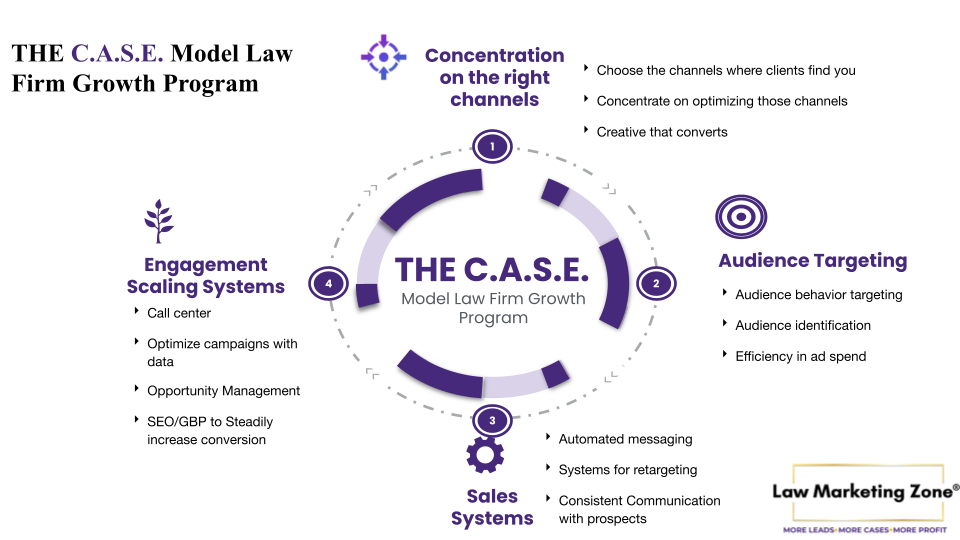
The C.A.S.E. Connection
The C.A.S.E. Connection
Reviews management sits at the intersection of Concentration and Engagement Scaling in the C.A.S.E. framework. A strong review profile makes every channel you invest in work harder. Your SEO ranking improves. Your Google Business Profile performs better. Your paid ads convert at a higher rate because the social proof is there when someone checks you out after seeing the ad. Your referral network is reinforced because people who were referred to you find confirmation of the recommendation when they look you up.
It's one of the few marketing investments that strengthens everything else you're doing simultaneously.
The One Thing to Get Right Before Anything Else
If we're being honest, reviews management is the foundation that everything else in your marketing strategy builds on. You can rank on page one of Google, run excellent ads, and have a polished social presence, and still lose the client if your review profile raises doubt at the moment of decision.
We typically recommend addressing reputation as part of the initial phase of any engagement, because the returns on every other marketing investment go up when the trust foundation is solid.
Answers
Frequently asked questions.
How do I get more Google reviews for my law firm without violating bar rules?
How should a law firm respond to negative reviews?
Do reviews on platforms other than Google matter?
How many reviews does a law firm need to rank in the Local Pack?
Can I remove a fake or unfair Google review?

Marilyn Jenkins
Founder, Law Marketing Zone®
is the founder of Law Marketing Zone® and has built reputation management systems for B2C law firms since 2018. She specializes in compliant review generation strategies for personal injury, family law, immigration, and criminal defense practices, with deep expertise in how review profiles influence both Local Pack rankings and AI-generated search results. Marilyn is the author of the 2026 Local SEO Playbook for Law Firms.
Your Move
Find out where your firm actually stands.
Your C.A.S.E. Growth Session walks through your current presence, the competitive landscape in your market, and a realistic roadmap for your practice areas. A working strategy session, not a sales call.
Schedule Your C.A.S.E. Growth SessionSpots are limited · Reserved for firms ready to scale