
Paid Search + AI Visibility
Google Just Changed How People Find Attorneys. Most Law Firms Haven't Caught Up Yet.
For the past decade, the formula for legal marketing on Google was straightforward. Run paid ads for high-intent keywords, rank organically for supporting terms, and make sure your Google Business Profile was clean. That formula still works. But it's no longer the whole picture.
Google Ads and AI visibility aren't competing strategies. They're interdependent ones.
Paid Search + AI Visibility for Law FirmsGoogle's Omni update and the rapid expansion of AI-generated search results have fundamentally changed what it means to be visible online. When someone searches "best personal injury attorney near me" or "what happens if I don't respond to divorce papers," they're increasingly seeing an AI-generated answer at the top of the page before they ever reach a paid ad or an organic listing. That AI answer cites specific firms and sources it considers authoritative. Everyone else is invisible.
The law firms that understand this shift and build for it right now are going to own their markets for the next decade. The ones that keep running the same playbook they ran in 2022 are going to wonder why their lead volume keeps declining despite spending the same budget.
We help elite B2C law firms do both things simultaneously. Generate immediate, qualified leads through Google Ads today, and build the AI authority signals that make your firm the one Google recommends tomorrow.
Why These Two Strategies Have to Work Together
Here's something most agencies won't tell you because it complicates their pitch. Google Ads and AI visibility aren't competing strategies. They're interdependent ones.
Your paid search campaigns drive immediate traffic and generate the behavioral signals, click-through rates, time on site, conversion rates, that Google's AI systems use to evaluate whether your firm is genuinely relevant and authoritative for the searches you're bidding on. A well-run PPC campaign doesn't just produce leads. It feeds the machine that determines your organic and AI visibility.
At the same time, a strong AI visibility foundation makes your paid ads more efficient. When a prospective client sees your ad, clicks through, and then finds a website with substantive practice area content, strong reviews, and clear expertise signals, they convert at a higher rate. You pay the same cost per click and get more cases out of it.
Running one without the other leaves money on the table. We run both, coordinated from the same strategic foundation.
The Google Omni Shift and What It Means for Your Firm
Google's Omni update represents the most significant change to search in years. Here's what it actually does and why it matters specifically for law firms.
Omni integrates Google's AI capabilities across the entire search experience. AI Overviews now appear at the top of results for a wide range of legal queries, generating synthesized answers that pull from sources Google considers authoritative. Below that, the traditional paid ads, Local Pack, and organic results still appear, but they're getting less attention than they used to because a significant portion of users are getting their initial answer from the AI summary.
For law firms, this creates two distinct visibility challenges. First, you need to be one of the sources Google's AI pulls from when generating those summaries. Second, you still need to be present and competitive in the paid and organic results below, because users who want to go deeper after the AI summary, which high-intent legal clients often do, are clicking those results.
We address both challenges with a single coordinated strategy.
What Google's AI Actually Looks for When Recommending a Law Firm
This is the part most agencies gloss over because it requires genuine expertise to execute. Google's AI systems don't recommend firms randomly. They look for specific signals that indicate a firm is genuinely authoritative and trustworthy in its practice areas.
Depth and specificity of content. A page that says "we handle personal injury cases" tells Google almost nothing. A page that explains the specific elements of negligence in Texas premises liability claims, what the statute of limitations is, what evidence matters most in the first 72 hours after an accident, and what the realistic range of outcomes looks like for different case types tells Google your firm actually knows what it's talking about. That's the kind of content that gets cited in AI Overviews.
Consistent entity recognition across the web. Google's AI systems build a model of who your firm is based on signals across dozens of sources. Your website, your GBP, your reviews, your legal directory listings, mentions in local press and bar association publications, your social profiles. When all of those sources consistently describe your firm in the same terms and attribute the same expertise to you, Google's confidence in recommending you increases significantly.
Review quality and recency. AI systems read your reviews, not just count them. A review that says "great attorney" contributes almost nothing to your AI visibility. A review that says "Marilyn's firm helped me navigate a complex custody modification after my ex-spouse relocated out of state, and they were responsive and clear throughout a stressful six-month process" is rich with signals about your expertise, your practice areas, your communication style, and your results. We build review generation systems that produce the kind of substantive reviews that feed AI visibility, not just star ratings.
Structured data and schema markup. Google's AI systems are significantly more confident recommending firms whose websites use proper legal schema markup. This tells Google's machines exactly what your firm is, who the attorneys are, what practice areas you handle, where you're located, and what your credentials are, in a language they can process without ambiguity.
What’s Inside
Our Google Ads Management for Law Firms
On the paid search side, we run tightly managed campaigns built specifically for B2C legal practice areas. This isn't generic PPC management with a legal skin on it. The keyword strategy, the ad copy, the landing page structure, and the bid management all reflect the specific dynamics of how personal injury, family law, immigration, and criminal defense clients search and convert.
Keyword Architecture Built Around Intent
We distinguish between informational searches, someone trying to understand their situation, and transactional searches, someone ready to hire an attorney. Both matter, but they require different ad strategies, different landing pages, and different follow-up approaches. We build campaigns that capture both without wasting budget on clicks that were never going to convert.
Ad Copy That Converts Under Pressure
The person clicking a legal ad is almost always in some form of stress or urgency. Ad copy that speaks to that emotional reality outperforms generic "experienced attorneys, free consultation" messaging consistently. We write and test ad creative that connects with where your prospective client actually is, not where a generic marketing playbook assumes they are.
Landing Pages Designed for Legal Conversion
We don't send paid traffic to your homepage. We build or optimize dedicated landing pages for each campaign that are structured around the specific search intent, the specific practice area, and the specific action you want the visitor to take. Every element of that page, the headline, the social proof, the form, the call to action, is tested and optimized for conversion.
Budget Management and Transparency
You see exactly where every dollar goes and what it produces. We manage bids, quality scores, and campaign structure to keep your cost per qualified lead as low as possible while maximizing call and consultation volume. No black box reporting. No inflated spend to pad our management fees.
What’s Inside
Our AI Visibility Strategy for Law Firms
Authority Content Development
We create substantive practice area content designed to answer the real questions your prospective clients are asking, in the depth and format that Google's AI systems recognize as genuinely authoritative. This is not blog content for its own sake. Every piece is built around a specific AI visibility objective tied to your core practice areas.
Conversational Search Optimization
People searching inside ChatGPT, Google's AI Mode, and voice search tools phrase their questions very differently than people typing keywords into a search bar. We optimize your content for natural language queries, which is how an increasing percentage of high-value legal searches are now conducted.
Entity and Schema Optimization
We implement comprehensive legal schema markup across your site and build consistent entity signals across your entire web presence, so Google's AI systems have a clear, authoritative model of your firm to draw from when generating recommendations.
GBP Authority Signals
Your Google Business Profile is one of the primary sources Google's AI pulls from for local legal queries. We optimize every element of your profile for AI visibility, including the service descriptions, the Q&A section, the review content strategy, and the posting cadence.
AI Mention Monitoring
We track when and how your firm is being referenced in AI-generated search results and conversational platforms, so we can identify what's working, what's missing, and where to focus the next phase of your authority-building efforts.
The Comparison That Matters
Most PPC agencies are still managing your campaigns the same way they did in 2020. Here's the practical difference between that approach and what we do.
A traditional PPC agency runs your ads, manages your bids, and sends you a report showing impressions, clicks, and cost per click. When your lead volume drops because AI Overviews are absorbing more of the search page, they don't have an answer for you because that problem is outside the scope of what they were hired to do.
We manage your paid search as one component of a coordinated visibility strategy. When the search landscape shifts, which it will keep doing, your marketing foundation shifts with it because it was built to adapt rather than to execute a fixed playbook.
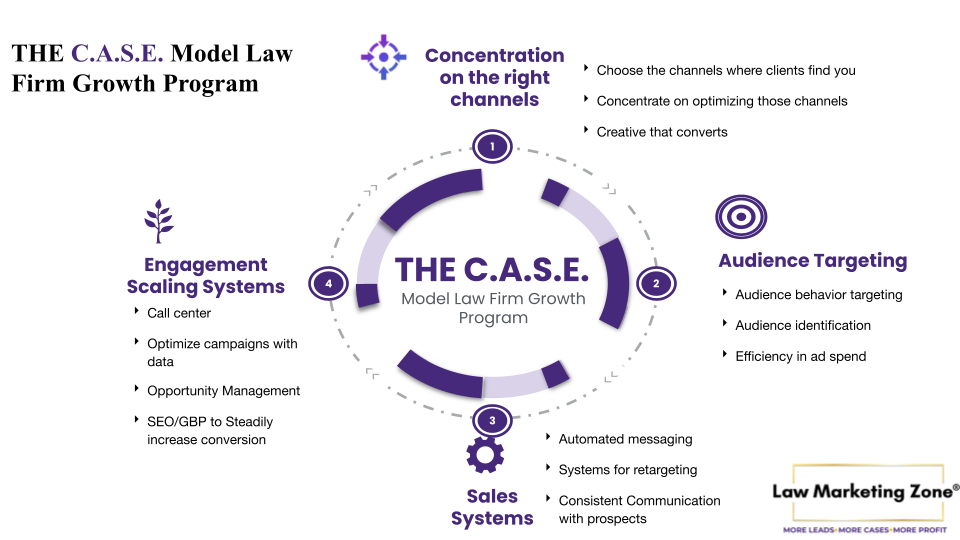
The C.A.S.E. Connection
The C.A.S.E. Connection
Paid search and AI visibility sit at the Concentration layer of the C.A.S.E. framework. They put your firm in front of the highest-intent prospective clients at the exact moment they're looking for an attorney, across every surface where those searches now happen. Combined with the Audience targeting precision of our campaign management and the Sales Systems that capture and nurture leads who don't convert on the first touch, this is how elite B2C law firms build consistent, predictable case volume rather than hoping the phone rings.
Answers
Frequently asked questions.
Does Google PPC still work for law firms in 2026?
What exactly is Google Omni and why does it matter for my firm?
How do you get a law firm cited in Google's AI Overviews?
How long before we see results from AI visibility optimization?
What B2C practice areas do you see the strongest results in?

Marilyn Jenkins
Founder, Law Marketing Zone®
is the founder of Law Marketing Zone® and a recognized authority on AI-driven search visibility for law firms. Since 2018, she has helped elite B2C law firms build coordinated paid search and AI visibility strategies through the C.A.S.E. Growth Program. She is the author of the 2026 Local SEO Playbook for Law Firms and host of the Leadership in Law podcast.
Your Move
Find out where your firm actually stands.
Your C.A.S.E. Growth Session walks through your current presence, the competitive landscape in your market, and a realistic roadmap for your practice areas. A working strategy session, not a sales call.
Schedule Your C.A.S.E. Growth SessionSpots are limited · Reserved for firms ready to scale